Google unveils TPU 8tx and TPU 8i Max – new AI chips for the agent era
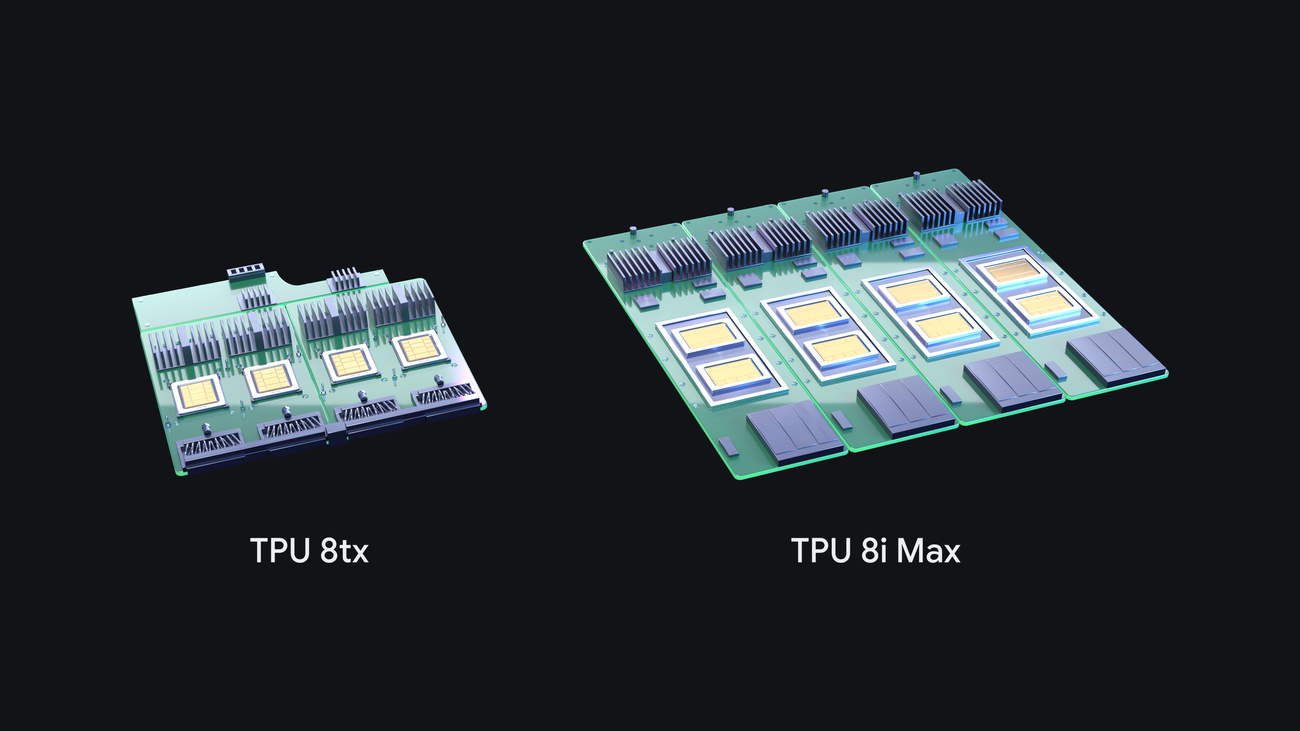
Google is expanding its eighth-generation AI processor lineup with the TPU 8tx and TPU 8i Max. These circuits are optimised for advanced hardware security and massive context windows in autonomous AI agents.
What happened?
Google has launched the TPU 8tx and TPU 8i Max, expanding its eighth generation of custom-designed AI processors. The TPU 8tx focuses on hardware-based security for sensitive data and confidential computing, while the TPU 8i Max is optimised to handle massive context windows for inference and autonomous agent workflows. The hardware integrates with frameworks such as PyTorch to facilitate development outside of Google's own environments.
Key facts
| Lanseringsdatum | 9 november 2026 |
|---|---|
| Hårdvarugeneration | Åttonde generationens TPU |
| Nya kretsar | TPU 8tx och TPU 8i Max |
| Totalt antal system i generationen | 4 system på ett år |
”We’ve expanded our eighth generation TPU portfolio with TPU 8tx and TPU 8i Max, marking four new TPU systems in a single year.”
Why it matters
The transition toward autonomous AI agents places extreme demands on memory and the processing of large context windows, while enterprises simultaneously require strict isolation of sensitive business data. By expanding its TPU offering, Google aims to reduce its reliance—and that of its customers—on Nvidia AI hardware, offering specialised chips for each stage of the AI lifecycle.
Who is affected?
The launch impacts AI developers, cloud engineers, and enterprise organisations building large-scale AI agents or training and running inference on models such as Gemini. It also provides new cloud-based options for organisations with strict data protection and regulatory compliance requirements.
Impact on the EU
The hardware will be available globally via Google Cloud, including data centre regions in Europe. The integrated hardware security in the TPU 8tx may assist European businesses in meeting data integrity and confidentiality requirements under GDPR.
What else you should know
Google reports that it has launched a total of four new TPU systems in the eighth generation over the past year, with the 8tx and 8i Max now complementing the 8t and 8i. The emphasis on PyTorch and open source is part of an effort to lower the barrier against Nvidia's dominant Cuda ecosystem.
Quick answers about this story
Vad har hänt?
När hände det?
Varför spelar det roll?
Hur får utvecklare tillgång till kretsarna?
The link opens in a new window and leads to the publisher's own site.
Källan har spårats automatiskt från utgivaren via Aheadlines signalkedja.
AI-verktyg i artikeln
Topics
Get similar news straight to your inbox
The reader's room
Send in a question or an addition. The newsroom reads everything before it's published and replies when relevant. No AI-generated text – just people.
Sign in to submit a comment or question.
Read the article through your role
- Decide whether this affects strategy over 6–12 months or is just noise.
- Discuss with leadership: do we own the right question or does ownership need to move?
- Ask: what risk are we taking by NOT acting on this this quarter?
Generated angle — not editorial analysis of "Google unveils TPU 8tx and TPU 8i Max – new AI chips for the"