Who holds the stopwatch? The EU's role as AI giants seek to slow the pace
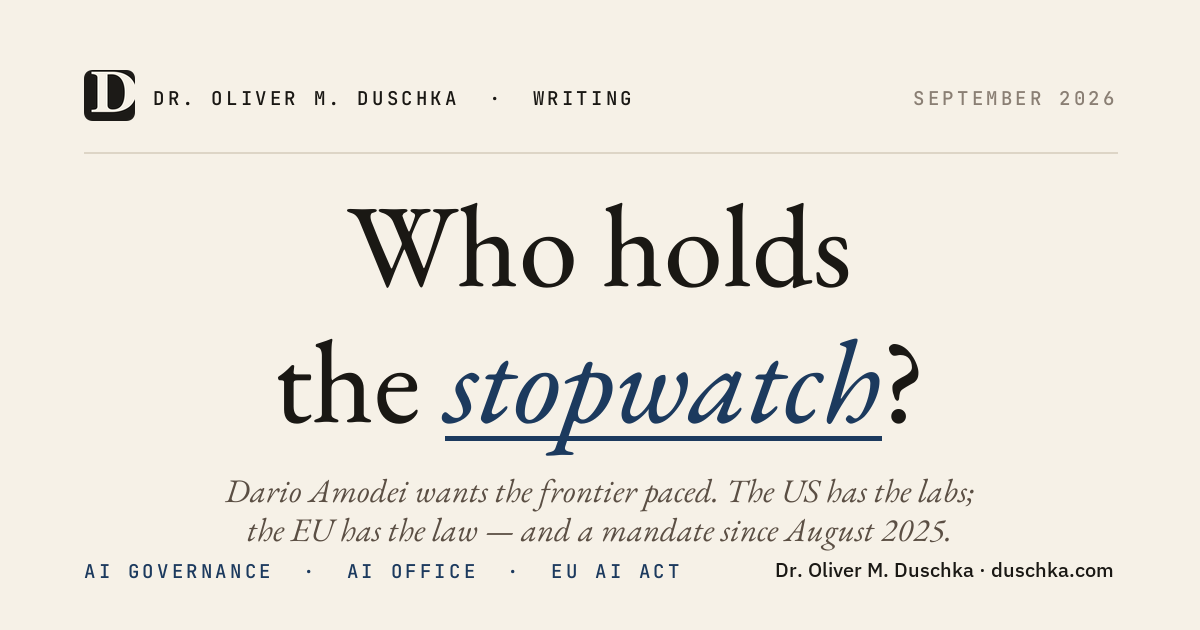
Anthropic CEO Dario Amodei is calling for a deceleration in the development of frontier AI models. In a new analysis, Dr. Oliver M. Duschka argues that the EU AI Act could provide Europe with a decisive role in this debate.
What happened?
On 12 September 2026, Anthropic CEO Dario Amodei published the essay 'We Must Pace the Frontier'. In the text, he calls on the AI industry to intentionally slow the development of advanced AI models. Dr. Oliver M. Duschka analysed the initiative in an essay published on 15 September 2026, raising the question of whether the EU AI Act could play a key role in regulating the rate of development.
Key facts
| Essä av Dario Amodei | 12 september 2026 |
|---|---|
| Essä av Dr. Oliver M. Duschka | 15 september 2026 |
| Huvudfokus | Begränsning av utvecklingstakt (pacing) |
Why it matters
Unlike previous demands for pauses or strict rules regarding deployment, Amodei’s proposal focuses on the pace of development itself. The objective is to allow research into alignment, interpretability, and operational safety to catch up. The analysis highlights how the EU, having already implemented the AI Act, has a unique opportunity to influence a global debate that has hitherto been driven primarily by the US.
Who is affected?
The news affects leading AI laboratories, technology developers, AI safety researchers, and policymakers in both the US and the EU. Businesses and consumers using advanced AI models will also be affected in the long term if the pace of development shifts.
Impact on the EU
The EU AI Act is already in force and regulates systemic risks for advanced AI models, but it does not explicitly address the pacing of development. European policymakers thus have an existing regulatory framework upon which to build should the issue of controlled development speed become a priority in the EU.
What else you should know
A central element of the debate concerns whether voluntary restraint by individual actors is sufficient, or if mandatory regulations from authorities in both the US and the EU are required to prevent a race to the bottom.
Quick answers about this story
Vad har hänt?
När hände det?
Varför spelar det roll?
Påverkar det EU?
The link opens in a new window and leads to the publisher's own site.
Källan har spårats automatiskt från utgivaren via Aheadlines signalkedja.
AI-verktyg i artikeln
Topics
Get similar news straight to your inbox
The reader's room
Send in a question or an addition. The newsroom reads everything before it's published and replies when relevant. No AI-generated text – just people.
Sign in to submit a comment or question.
Read the article through your role
- Decide whether this affects strategy over 6–12 months or is just noise.
- Discuss with leadership: do we own the right question or does ownership need to move?
- Ask: what risk are we taking by NOT acting on this this quarter?
Generated angle — not editorial analysis of "Who holds the stopwatch? The EU's role as AI giants seek to "